top of page
.png)

Our Story
The games played in communities highlight the essential skills for, emphasizing strength, agility, and endurance. They served as a way for parents to teach their children resilience across all aspects of life. Historically, these featured feasts, dances, and games, often announced through messengers to neighboring villages. Today, such games continue in rural areas during holidays like the Fourth of July and Christmas, celebrating communal achievements and showcasing athletic talents.
History of WEIO
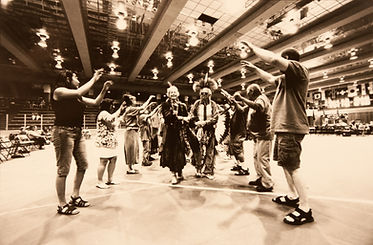
For time immemorial, Native peoples of the circumpolar areas of the world have gathered in small villages to participate in games of strength, endurance, balance, and agility. Along with these athletic games, dancing, storytelling, and other audience participation games took place. This provided an opportunity for friendly competition, entertainment and laughter. The hosts provided food and lodging, and visitors brought news from surrounding villages and expanded opportunities for challenge building and renewing old and making new friendships. This is the background of the World Eskimo-Indian Olympics and the atmosphere, which we seek to replicate.
1961 - The First Games
The first World Eskimo Olympics was held in Fairbanks in 1961 drawing contestants and dance teams from Barrow, Unalakleet, Tanana, Fort Yukon, Noorvik and Nome. The event was a big success and has been held annually ever since.
In 1961, the City of Fairbanks, through the Fairbanks Chamber of Commerce, sponsored the World Eskimo Olympics as a segment of the emerging Golden Days Celebration. The chamber's involvement continued through the 1969 games. The late A. E. "Bud" Hagberg and Frank Whaley, Wien Airways employees, who are credited as the organizers of the World Eskimo Olympics; co-chaired the first several events, while Bill English and Tom Richards, Sr., pilots of the airlines, served as emcees. The rapidly developing State of Alaska, along with the influence of non-Native cultures in rural Alaska, led to a fear the games might be forgotten and not passed on and shared with others.
Four Eskimo dance groups, two Indian dance groups, along with competitors in the high-kick, blanket toss, seal skinning, and Miss Eskimo Olympics Queen Contest participated that first year. Exhibitions on the teeter board and Eskimo "piggy back" baby buggy show rounded out the short program. From this beginning, a diverse and complex format encompassing four days was born.
1970 - The Change
In 1970, Tundra Times, the only statewide Native newspaper in Alaska, by mutual agreement with the Fairbanks Chamber of Commerce, took over sponsorship of the growing event. It was viewed by the Tundra Times Board of Directors as a potential fundraiser to assist the newspaper in its mission; defined by the late Howard Rock, founder and editor, to aid the Alaska Native movement toward better solutions to the problems they confronted for decades.
In 1973, the Board of Directors of the Tundra Times passed a resolution changing the name of the World Eskimo Olympics to World Eskimo-Indian Olympics to more accurately reflect the ethnicity of the participants.
1976 - Formation of WEIO
Each year record-breaking crowds, record-breaking performances by the athletes, an increasing number of competitors, and larger numbers of villages sending dance groups and athletes to the Games proved to be a challenge to the sponsoring organization. In 1976, an independent, non-profit corporation was formed for the sole purpose of a planning, preparing, and staging the annual event. The World Eskimo-Indian Olympics, Inc. is a 501-(c)(3) organization run by a dedicated group of supporters and volunteers.
Gate proceeds, merchandise sales, and donations from friends and corporate partners provide revenue and services to cover expenses of the annual event, and run the business of the organization.
Throughout its over 60 year history, the organizers of WEIO have seen print and film crews from all over the globe. Magazines such as Cosmopolitan, People and USA Today, have offered articles on the WEIO Games. Some of the participants have been on nationwide television shows such as Good Morning America, the Learning Channel, the Discovery Channel, CNN, ESPN and the Tonight Show. Many international television programs have done specials starring the people, athletes and events of the WEIO. Strange as these games may be to some, the organizers strive to present these games as an important connection to our traditional cultures; rich with history, stories, and spirituality.
Looking to the Future
Survival for Alaska Native peoples has always required disciplined bodies, sharp minds, and deep respect for the land, and those same values are at the heart of WEIO today. The traditional games that once prepared hunters and families to endure harsh conditions now promote wellness, resilience, and healthy lifestyles for our communities. Through vibrant cultural celebrations that bring together athletes, dancers, elders, and youth, WEIO honors the skills that meant the difference between life and death while creating joyful spaces for connection. By centering intergenerational learning—listening to elders’ stories, teaching young people the games, and sharing knowledge across families—we help ensure that the strength, cooperation, and reverence for nature that sustained our ancestors continue to guide future generations.


Help Carry the Tradition Forward
WEIO’s history lives on through the people who show up, give back, and share in the celebration. Join us in promoting wellness, cultural pride, and intergenerational learning for future generations.


bottom of page